Skip to the timeline
Enigma

The history
of Enigma

Enigma machines encrypted messages to protect their contents.

The German military used Enigma to encrypt communications. Polish, French and British cryptanalysts developed methods to recover its keys and read intercepted messages.

01

Scherbius files a patent for an electrical cipher machine.

German engineer Arthur Scherbius files a patent for an electrical cipher machine, later developed into Enigma. His design uses a series of rotating wired wheels to transform each typed letter into another. The electrical path changes as the wheels turn.
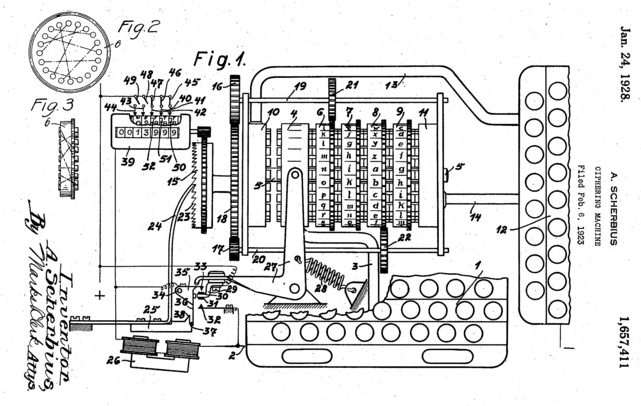
Figs. 1–3 from Arthur Scherbius’s US patent 1,657,411, published in 1928, redrawn with moving parts. The key sequence, wheel wiring and current path are illustrative. Arthur Scherbius · Public domain · Wikimedia Commons ↗
Sources & notes 2

1918 is the German application date, not the patent's publication. The illustration is explicitly a later US patent drawing, published in 1928.

02

Enigma goes on sale.

Scherbius's company markets Enigma to the public, mainly for commercial and banking correspondence. The early Handelsmaschine uses four permanently installed cipher rotors and prints its output on paper.

Preparing the model…

Die Handelsmaschine · 1923

Die Handelsmaschine · 1923. Cover removed to show all four rotors. The typing and printing motion is illustrative; the original carriage was returned by hand.
Sources & notes 1

No surviving Handelsmaschine is known. Older histories often call the early printing machines "Enigma A" and "B". This timeline follows revised archival research distinguishing the Handelsmaschine from the later A and B lamp machines. Model dimensions and finishes are inferred, and the demonstration uses a synthetic cipher.

03

Enigma A is demonstrated at the Universal Postal Union Congress in Stockholm.

Light bulbs above the two rows of keys display the output letters. This early version has two cipher rotors and a separate button to advance the mechanism.

Preparing the model…

Enigma A · Later 1924

Enigma A · Later 1924. This reconstruction represents the later-1924 version with a settable reflector and a separate advance before each letter.
Sources & notes 3

No surviving specimen or authenticated wiring is known: case shape, materials and interior are reconstructed, with a synthetic reciprocal circuit and exhibit A–Z inserts for the originally blank, replaceable labels. November explicitly describes the manually settable third wheel later in 1924; August already gives a key such as R 15 22 and over 17,000 key-enciphering possibilities, leaving the Stockholm configuration uncertain.

04

Enigma B advances the rotors on each keypress.

An improved Enigma B is delivered to Sweden with three removable rotors and adjustable index rings. A ratchet and pawl mechanism advances the rotors when a key is pressed.

What changed

Three removable wheels, ring settings and automatic stepping. This Swedish version still uses an alphabetic, 28-character keyboard.

Preparing the model…

Enigma B · A-133 · 1925

Enigma B · A-133 · 1925. The Swedish A-133 has Å, Ä and Ö but no W. Its three rotors advance automatically before the encrypted letter lights.
Sources & notes 1

This model follows the surviving Enigma B Mark II A-133 delivered to Sweden on 6 April 1925, rather than the earlier two-rotor B offered in late 1924. Rotor I has letters; II and III have numbers 01–28. Its rotor and reflector permutations are published, but the entry-wheel wiring remains unverified and is assumed alphabetic here. Hidden dimensions and wire routes are reconstructed. The exhibit starts with I–II–III and rings A–01–01; physical thumbwheels change the starting positions.

06

Enigma D introduces QWERTZ keys and lamps.

The Enigma D introduces QWERTZ keys and lamps, a hinged rotor cover, and a reflector adjustable to 26 positions. Of its four visible setting wheels, three are driven cipher rotors and one sets the reflector.

What changed

A settable reflector beside three rotors. There is no front plugboard.

Preparing the model…

Enigma D

Enigma D. Three driven rotors and a hand-set reflector. The folded pawls advance the ratchets; the reflector stays still.
Sources & notes 1
07

Enigma K moves the turnover notch to the index ring.

The A27, later known as Enigma K, succeeds the D. Its turnover notch is attached to the adjustable index ring rather than the rotor body. This changes the relationship between the ring setting and rotor turnover.

In Britain, Hugh Foss analyses an acquired commercial A26. His work concerns commercial Enigma, which has no plugboard.

Preparing the model…

Enigma K · A27 · A818

Enigma K · A27 · A818. Four setting wheels can be turned by hand. The leftmost is a reflector that stays still during typing; the three cipher rotors advance.
Sources & notes 2

The name K appears from 1936, although A27 dates to 1927. This reconstruction follows Crypto Museum’s A818, dated to late 1927 or early 1928, with its published standard commercial wiring. Small dimensions and concealed wire routes are reconstructed; this is not a measured replica. The starting settings are I–II–III, rings AAA and reflector A. External power has no supply connected in this exhibit.

08

The Army introduces Enigma I with a plugboard.

The German Army’s Enigma I enters service after several years of development. A plugboard on the front of the machine swaps pairs of letters as the current enters and leaves the rotors. Operators arrange three rotors, I, II and III, in any of six orders beside a fixed reflector.

What changed

The plugboard, fixed reflector and military wiring distinguish Enigma I from its commercial relatives.

Preparing the model…

Enigma I

Enigma I. QWERTZ plugboard sockets and rotor rims numbered 01–26. The inspector demonstrates the middle rotor advancing on consecutive strokes.
Sources & notes 2

Enigma I uses the Roman numeral I. It is distinct from the naval M1. This service date predates Hitler’s accession in 1933.

09

Enigma G31 uses gears and a moving reflector.

The compact G31 develops the counter-machine branch begun with the A28. A gear drive gives the rotors frequent turnovers and also moves the reflector. A counter records the number of letters typed. Often associated with the Abwehr, it also has other military customers.

What changed

Geared stepping, a moving reflector and a counter, without a plugboard. This is a separate branch, not an Army-wide replacement.

Sources & notes 1
11

Polish cryptanalysts reconstruct military Enigma.

Marian Rejewski reconstructs the military machine’s internal permutations using mathematics, intercepted messages and intelligence supplied through France. Together with Jerzy Różycki and Henryk Zygalski, he develops methods to recover its changing keys.

Cryptanalysts must continue recovering keys and adapting to changes in procedure. Later Allied work builds on the Polish methods.

Marian Rejewski as a Polish Army signals officer in Britain, 1943 or 1944.
Marian Rejewski as a Polish Army signals officer in Britain, 1943 or 1944. Unknown photographer · Public domain · Wikimedia Commons ↗
Sources & notes 2
14

Reflector B requires a new catalogue.

Reflector B replaces reflector A. Polish cryptanalysts have used a device called the cyclometer to catalogue the patterns produced by every rotor order and starting position. The new wiring makes the catalogue useless, and they must compile it again.

What changed

New reflector wiring, without another rotor position.

Sources & notes 1
15

Polish cryptanalysts develop sheets and the bomba.

A changed German indicator procedure defeats the existing catalogue method. Polish responses include Zygalski’s perforated sheets and Rejewski’s electromechanical bomba, designed to exploit repetitions in message indicators.

Sources & notes 1

The Polish bomba and the later British bombe are related parts of the history, but use different cryptanalytic designs.

16

Operators choose three rotors from a set of five.

The addition of rotors IV and V gives Army and Air Force operators five wheels to choose from. Three are still fitted at a time, but the possible orders rise from six to sixty, multiplying the work required of the Polish methods.

What changed

A larger selection of rotors, not a five-rotor machine.

Preparing the rotors…

The five Army / Air Force rotors

The five Army / Air Force rotors. Each wheel is identified by a Roman numeral, I to V, and has one turnover notch. The numbers 01–26 around the rim show its position.
Sources & notes 1

The 3D collection uses the Army / Air Force’s numbered rims. Dimensions and finishes are reconstructed, and the display arrangement is not a historical storage box.

17

The Navy gains three additional wheels.

Naval wheels VI, VII and VIII enlarge the available set to eight. Each new wheel has two turnover notches, changing its stepping pattern. Three wheels are still installed.

Naval rims use A–Z, while Army and Air Force rims use 01–26: A corresponds to 01, B to 02, and Z to 26. The Navy used lettered rims before the 1939 expansion.

What changed

Additional naval rotors with two turnovers each.

Preparing the rotors…

The eight naval rotors

The eight naval rotors. All eight have lettered rims. I–V retain the same wiring as their Army counterparts, while VI, VII, and VIII each have two turnover notches.
Sources & notes 2

Crypto Museum dates the additional naval wheels to 1939 and documents lettered rims on surviving M1 M522, manufactured in 1934. This does not establish an exact introduction date for alphabetic rings. The collection reconstructs dimensions and finishes but does not reproduce every service-specific ring-release fitting. Mathematical combinations do not establish which orders an operational key permitted.

18

Poland shares its methods with Britain and France.

At Pyry, outside Warsaw, Polish cryptanalysts explain their achievements to British and French representatives. They share their reconstruction of Enigma and methods for recovering its keys before the war begins.

After Germany invades Poland, Polish cryptanalysts continue their work in France, cooperating with French and British teams.

Sources & notes 1
19

Bletchley Park becomes a wartime centre.

Britain’s Government Code and Cypher School builds its wartime operation at Bletchley Park. Alan Turing concentrates on naval Enigma, while interconnected teams attack different networks and turn intercepted radio traffic into intelligence.

The mansion at Bletchley Park, photographed in 2017.
The mansion at Bletchley Park, photographed in 2017. DeFacto · CC BY-SA 4.0 · Wikimedia Commons ↗
Sources & notes 2
20

The British bombe searches for settings.

The first British bombe, Victory, arrives in March. Turing’s design tests deductions from a guessed passage of plaintext—a crib. Gordon Welchman’s diagonal board makes the search more effective. The first bombe fitted with it, Agnus Dei, arrives in August.

Built by the British Tabulating Machine Company, bombes find candidate settings for further checking. They do not simply print a translation of every intercepted message.

The reconstructed British bombe at Bletchley Park, photographed in 2015.
The reconstructed British bombe at Bletchley Park, photographed in 2015. The Turing Bombe Rebuild Project, Bletchley Park, Milton Keynes, Buckinghamshire by Christine Matthews · CC BY-SA 2.0 · Wikimedia Commons ↗
Sources & notes 2

Museum accounts disagree on the exact March arrival day, so the timeline uses the month. The photograph shows a modern reconstruction, not Victory itself.

22

Captured documents help decrypt naval messages.

The capture of U-110 yields naval cipher material, including indicator books. Weather-ship captures also supply keys. These documents help cryptanalysts decrypt naval messages.

A captured Enigma alone cannot provide access to every message. Current keys, codebooks, operating procedures and cryptanalysis are also needed.

U-110 after its capture by Royal Navy ships on 9 May 1941.
U-110 after its capture by Royal Navy ships on 9 May 1941. Royal Navy official photographer · Public domain · Wikimedia Commons ↗
Sources & notes 1
23

M4 interrupts Allied decryption of U-boat messages.

The U-boat Triton network—Shark to Bletchley Park—switches to four-wheel operation. A thin extra rotor and thinner reflector fit into the naval machine’s existing width. The added wheel is set by hand and does not step while a message is typed.

The new arrangement and procedures interrupt Allied reading of this network. Access to other Enigma networks depends on their own keys and procedures.

What changed

A thin fourth rotor, set by hand, beside the three moving rotors.

Preparing the model…

Enigma M4

Enigma M4. The thin β wheel has its own retaining roller, but no driving pawl. It is set by hand, and only the three ordinary wheels advance during typing.
Sources & notes 2

1 February dates operational four-wheel use on this network, not a simultaneous replacement of every naval Enigma. The blackout extends into December, not just to the October capture.

24

Codebooks from U-559 help restore Shark decryption.

British sailors recover codebooks from the sinking U-559. The material helps Bletchley Park attack Shark again. In December, recovered weather messages begin yielding useful U-boat positions for the Admiralty.

Sources & notes 1

The capture on 30 October and the resumption of useful reading in December are different milestones. The recovery relied on both captured documents and cryptanalysis.

26

The reflector becomes rewirable.

The Luftwaffe introduces UKW-D, whose internal connections can be rearranged in the field. Its use is limited, and older reflector systems remain in service alongside it.

What changed

Changeable reflector connections. No additional stepping rotor.

Sources & notes 1
27

Enigma Uhr changes plugboard connections.

The Luftwaffe’s Enigma Uhr connects to the front plugboard. A forty-position switch changes the interconnection pattern. Bletchley Park encounters its traffic in July and solves the system within days.

What changed

An external plugboard accessory, not a clock driving the rotors.

Sources & notes 1
28

Nearly 10,000 people work at Bletchley Park.

By 1945, Bletchley Park employs nearly 10,000 people, roughly three quarters of them women. Interception, translation, indexing, traffic analysis, engineering and machine operation make cryptanalytic breakthroughs usable.

Enigma-derived intelligence contributes to Ultra, the closely protected intelligence supplied to Allied commanders. Not every key is recovered, and a message read too late may have little operational value.

Sources & notes 4

Ultra is not a machine. Colossus attacked Lorenz teleprinter traffic, known at Bletchley Park as Tunny. It was a different cipher system, and Colossus did not replace the Enigma bombe.

29

Enigma remains in use after the war.

Enigma remains in service after the defeat of Nazi Germany. In Norway, captured machines are adapted with new rotor and reflector wiring for police use. Other postwar users also retain machines.

Allied codebreaking remains largely secret after the war. Veterans cannot discuss their work, and historians lack access to the intelligence records. Later disclosures change accounts of wartime campaigns.

Sources & notes 4
32

The Ultra Secret publicises Allied codebreaking.

F. W. Winterbotham’s The Ultra Secret makes wartime Allied codebreaking widely known to English-language readers. The book reveals the scale of the intelligence operation to a wider audience.

Earlier Polish and French publications had already described parts of this work. Later records and research correct errors and omissions in Winterbotham’s account.

Sources & notes 1
33

Dönitz learns how much the Allies had read.

Karl Dönitz, the former commander of Germany’s U-boat force and later head of the Navy, learns the extent of Allied access to naval Enigma. Naval historian Jürgen Rohwer later describes his shock at the revelation.

Bundesarchiv portrait of Karl Dönitz, April 1943.
Bundesarchiv portrait of Karl Dönitz, April 1943. Bundesarchiv, Bild 146-1976-127-06A / CC-BY-SA 3.0 · CC BY-SA 3.0 DE · Wikimedia Commons ↗
Sources & notes 1

This paraphrase follows a 1990 naval-history review reporting Rohwer’s account. No authenticated contemporary transcript has been established here, so no words are placed in Dönitz’s mouth. The portrait dates to April 1943, not the 1974 revelation.